
Chisago County Court Records After a Jail Arrest
After a Chisago County jail arrest, three systems may matter at the same time. The Chisago County Inmate Locator is the custody side. It can show a booking number, custody date, physical descriptors, bail amount, court date, charge grid, and holds. The Chisago County Attorney then reviews law enforcement reports and decides what criminal complaint or other charging document should be filed. Once filing occurs, Chisago County District Court and Minnesota Court Records Online, usually called MCRO, become the main places to check the formal court records after an arrest.
The booking record and the court record should not be treated as the same thing. The jail roster can be useful for current custody, early bail information, a hold reason, or a court branch field, but the roster itself warns that inmates going through booking may have incomplete or missing charge details until booking is finished. Use jail inmate records for the roster and custody side, and use jail mugshots for booking photo questions. Use court records after a jail arrest to confirm the prosecutor-filed charges, case number, hearing history, public documents, and final disposition.
The Chisago County Attorney is Janet Reiter. The County Attorney's Office is the chief prosecutor for felony, gross misdemeanor, misdemeanor, petty misdemeanor, and juvenile offenses committed within Chisago County, according to the county's criminal-process materials. The office is at 313 N Main St, Suite 370, Center City, MN 55012, and the phone number is 651-213-8400. The Criminal Division prosecutes cases for the state and does not represent defendants or give defense legal advice.
District Court and MCRO Case Access
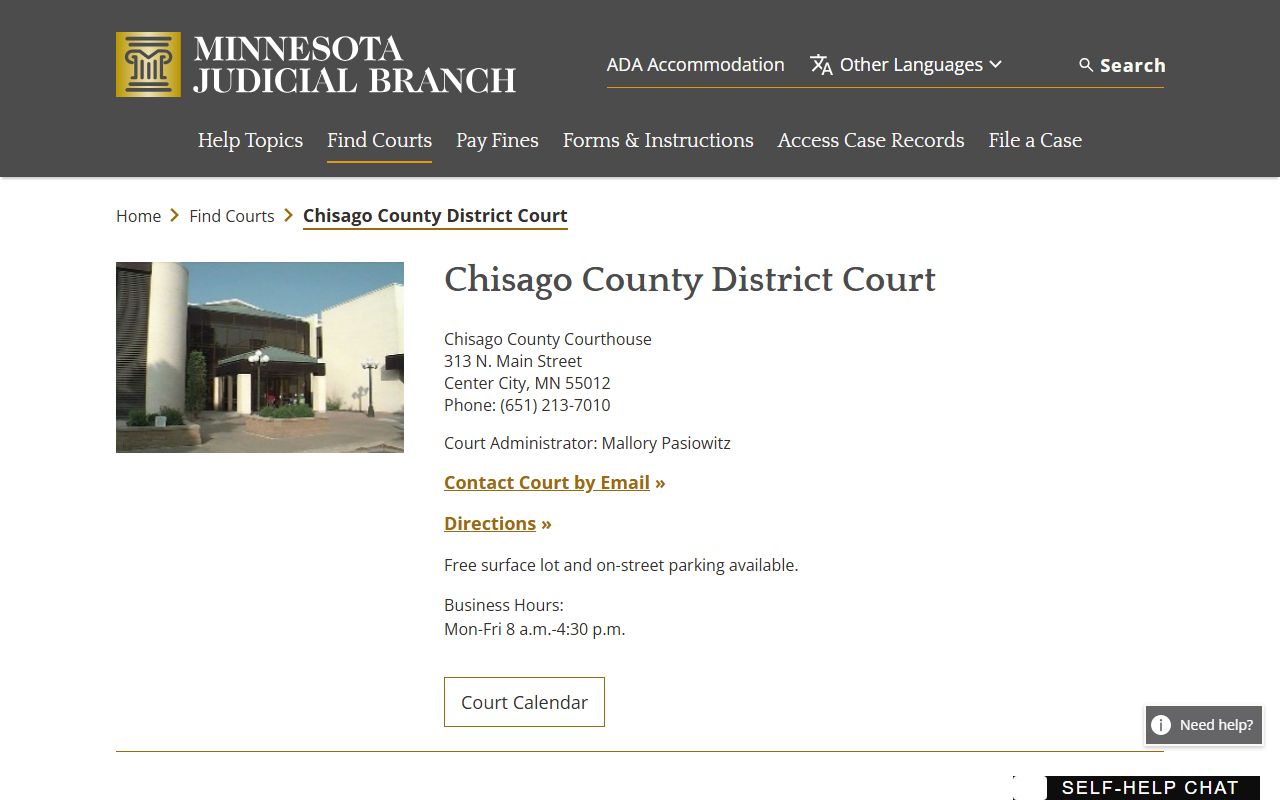
Chisago County District Court is at the Chisago County Courthouse, 313 N. Main Street, Center City, MN 55012. Court Administration can be reached at 651-213-7010. The Minnesota Judicial Branch lists Mallory Pasiowitz as Court Administrator and gives business hours as Monday through Friday, 8 a.m. to 4:30 p.m. The court is part of the Tenth Judicial District and handles criminal, traffic, juvenile, civil, family, and probate matters filed in Chisago County.
The Minnesota Judicial Branch page for Chisago County District Court is the source for courthouse contact details, parking notes, hours, and calendar links.
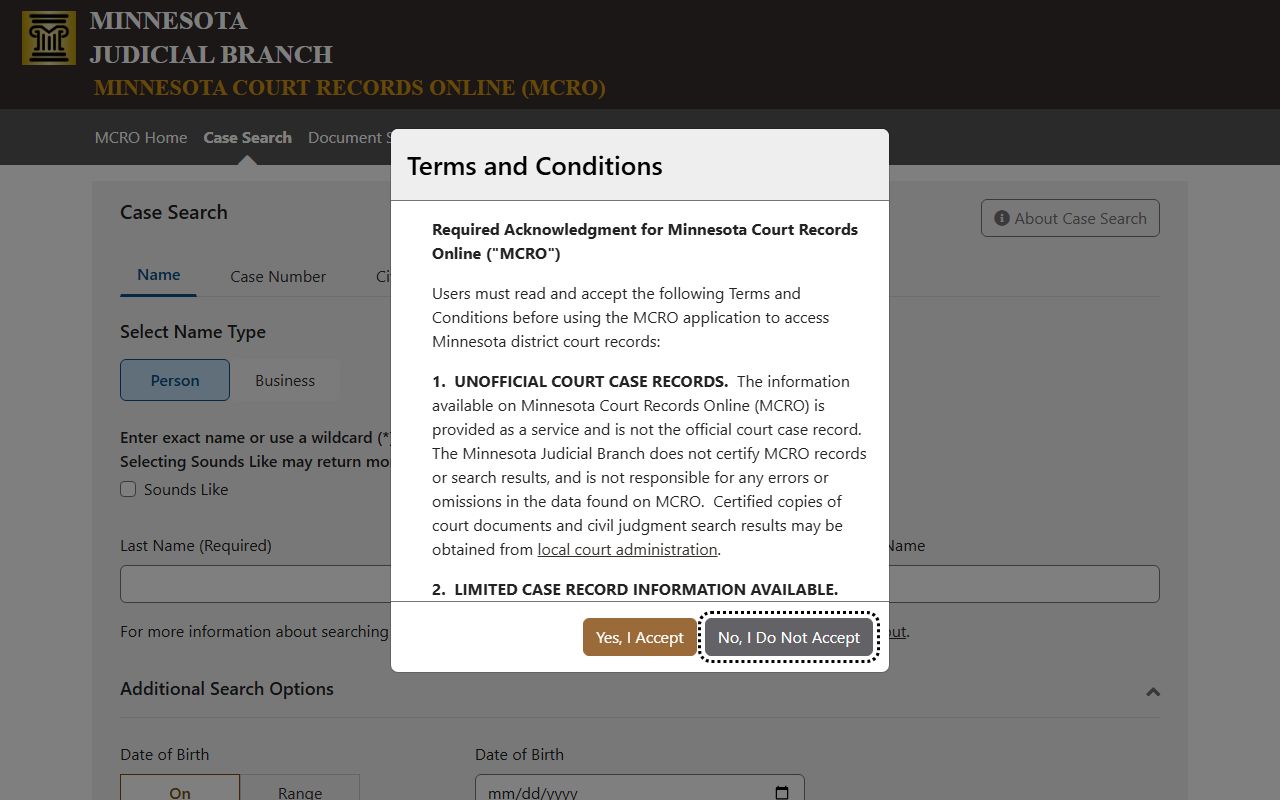
Minnesota Court Records Online is the statewide public case-search portal for district court records. The MCRO case-search screen is at publicaccess.courts.state.mn.us/CaseSearch and includes name, case number, citation number, and attorney search tabs.
How to Find Chisago County Court Records After an Arrest
Start with the county jail roster only long enough to collect identifiers, then move to MCRO for the court case. The roster may show a booking number, bail amount, court date, and preliminary charges. Those details help narrow the search, but they do not replace the filed criminal case. MCRO states that its online records are unofficial and that certified copies must come from court administration. It also warns that remote access is limited by Minnesota public-access rules, so some records available at courthouse terminals may not appear online.
- Open the Chisago County Inmate Locator and look for the person's booking number, name spelling, custody date, bail field, and any court date or court branch information.
- Open MCRO and search by defendant first and last name. Add the date of birth if known to avoid mixing people with similar names.
- Select Criminal as the case category and use the county location filter for Chisago County when the search screen allows it.
- Open the case result and compare the case number, charge descriptions, statute references, hearing dates, register of actions, documents, and disposition to the jail record.
- If no case appears, check whether the prosecutor has not filed yet, the name differs from the booking record, remote-access rules limit visibility, or the case was filed in another county.
- For certified copies or records not visible online, contact Chisago County District Court at 651-213-7010.
| MCRO Field | Type | Use for an Arrest Case |
|---|---|---|
| Case Search tabs | Tab buttons | Use Name first if the case number is unknown; use Case Number when the roster or court calendar gives one. |
| Name type | Tab buttons | Choose Person for a defendant search. |
| Last Name | Text | Required for a person name search and usually the best first filter. |
| First Name | Text | Required for a person name search. |
| Middle Name | Text | Optional, but useful when common names produce too many results. |
| Soundex | Checkbox | Can help when spelling varies between a booking record and a court filing. |
| Date of Birth | Date input | Exact date or range, entered in MM/DD/YYYY format when known. |
| Date Filed | Date input | Use a range around the arrest or first-appearance date. |
| Case Category | Checkboxes | Select Criminal for cases following a jail arrest. |
| Case Status | Dropdown | All is broadest; Active can narrow a recent arrest case. |
| Court Locations | Radio and search field | Use County and select Chisago to limit results to local District Court filings. |
How Charges Get Filed After an Arrest: Complaint, Information, and Indictment
The arrest-to-court path in Chisago County begins with custody, but the court case begins with a filing. A sheriff's deputy, city officer, warrant, or court order can bring someone into the Chisago County Jail booking process. Jail staff identify the person, create or update the booking record, and may display preliminary charges and bail fields on the roster. The County Attorney's Office then reviews the reports and may file a criminal complaint, pursue charges through other procedures, make sentencing recommendations, present cases before a grand jury, and represent the state at hearings and trial.
| Complaint | Information | Indictment | |
|---|---|---|---|
| Filed By | Prosecutor, based on law enforcement reports and probable cause. | Prosecutor, commonly after a waiver or later-stage charging process. | Grand jury, with prosecutor presentation. |
| Common For | Misdemeanor, gross misdemeanor, felony, and juvenile matters where a complaint is used. | Felony or serious case posture where Minnesota procedure allows it. | More serious felony matters requiring or using grand-jury action. |
| Starts | The formal criminal court case and case number. | The formal accusation in the court case. | The formal charge returned by the grand jury. |
| What to Compare | Complaint counts against roster charges and police report language. | Information counts against earlier complaint or amended charges. | Indictment counts against any earlier arrest or hold reason. |
Minnesota Rule of Criminal Procedure 4 affects timing after arrest. An arrested person who is not released must be brought before a judge without unnecessary delay and within the rule's 36-hour framework, excluding the day of arrest, Sundays, and legal holidays, or as soon as a judge is available. That first appearance may set release conditions and create visible court events even when later filings continue to develop.
Charge Status and What It Means
Charges can move quickly after a Chisago County arrest. The jail roster may show one set of booking charges while the prosecutor files a different set of formal counts. A charge may be added, amended, reduced, dismissed, or resolved by plea or verdict. MCRO, court administration, and the charging documents are better sources than the jail roster for the official court status.
| Status | What It Means |
|---|---|
| Pending | The charge is active and has not reached final disposition. Hearings, motions, plea negotiations, or trial may still be ahead. |
| Amended / Reduced | The prosecutor or court record changed the charge, statute, severity level, or count. Compare old and new counts before drawing conclusions. |
| Dismissed | The charge was removed from the case or ended without a conviction on that count. Other counts may still remain. |
| Convicted | The defendant was found guilty or entered a guilty plea on that count. Sentencing and probation terms may appear separately. |
| Acquitted | A trial ended with a not-guilty finding on that count. |
| Hold / Detainer | A custody note may come from another agency, warrant, probation matter, DOC, federal, or immigration issue, separate from a Chisago charge. |
Bond and Release After an Arrest
The Chisago inmate detail panel includes a Bail Amount field, and the charge grid includes Bail Amt and Type columns. The research did not locate a county-published bond payment-method table for jail bonds, so bond details should be confirmed for the specific case. Release conditions can be set by warrant terms, a bail or bond schedule where applicable, court order, or a judge at first appearance. A person can remain in custody even after a local charge appears payable if another hold, detainer, probation violation, DOC matter, federal case, or court condition prevents release.
| Bond Type | How It Works |
|---|---|
| Cash Bail / Bond | Money is paid to secure release and future court appearance. Confirm the amount and payment method with the jail or court. |
| Conditional Release | The court allows release subject to conditions, which may include no contact, testing, supervision, or travel limits. |
| Personal Recognizance | Release is based on a promise to appear, sometimes with added conditions. |
| Surety Bond | A surety or bail-agent mechanism may be used where allowed. Local acceptance must be verified with court or jail staff. |
| No-Bond Hold | No payment path is available until a court or holding agency changes the status. |
| Agency Hold / Detainer | Another agency asks the jail to hold the person or notify before release. |
For a practical release check, search the inmate locator, call Chisago County Jail at 651-257-2931 before going to the facility, and compare the roster with MCRO for court release orders. Warrant questions can also involve Court Administration at 651-213-7010 or Sheriff's Office routing.
Warrants That Lead to an Arrest
No official Chisago County searchable active warrant database was located in the county materials. The county FAQ directs warrant questions to Court Administration at 651-213-7010 or the Sheriff's Office. Other county pages list Chisago County Dispatch at 651-257-4100 and the Sheriff's Office main number at 651-213-6300. An arrest warrant, bench warrant, probation warrant, DOC warrant, or outside-agency hold can lead to jail booking and then to court records after an arrest.
Chisago County Jail also accepts walk-in warrants. The county jail programs material says a person should arrive at the Public Safety Center lobby by 6:00 a.m. to allow adequate booking time and a possible same-day court appearance. A valid government-issued photo ID is required. Once booked, the roster may show a hold grid with Hold Reason and Agency, while MCRO may show the court case or warrant-related hearing activity.
Charges vs. Convictions in Court Records After Arrest
A jail arrest and a filed charge are not the same as a conviction. The roster and MCRO can show accusations before any finding of guilt. The Chisago inmate locator disclaimer also warns that booking does not establish guilt or conviction and that the information should not be relied on for legal action. Treat each charge as an allegation unless the court record shows a plea, verdict, or other final disposition.
| Charge | Conviction | |
|---|---|---|
| Stage | An accusation filed by the prosecutor or reflected in a complaint, information, indictment, citation, or court count. | A final finding after a guilty plea, guilty verdict, or other conviction entry. |
| Burden of Proof | Generally begins with probable cause or charging standards. | Requires proof beyond a reasonable doubt or a valid guilty plea. |
| Public Record | Often public, subject to Minnesota access limits and case type restrictions. | Often public, but still subject to sealing, expungement, juvenile, and remote-access rules. |
| Practical Use | Use to understand what the state alleges and what hearings are pending. | Use to understand the final outcome, sentence, probation, or later DOC custody. |
Sealed vs. Expunged Court and Arrest Records
Minnesota access rules can limit what is visible online even when some courthouse access remains available. MCRO notes that remote access is limited by the Minnesota Rules of Public Access. Examples include certain domestic-abuse or harassment matters, some child-protection and juvenile delinquency felony records, public documents in civil-commitment cases, and party address or comment fields. Separate from remote-access limits, Minn. Stat. ch. 609A governs criminal record expungement for eligible cases.
| Sealed | Expunged | |
|---|---|---|
| Visibility | Restricted from ordinary public access, though authorized users or agencies may retain access depending on the order. | Sealed under Minnesota expungement procedures for eligible records. The practical effect depends on the statute and court order. |
| Law Enforcement | May still be available to law enforcement, courts, or agencies under specific rules. | May still be available to certain agencies depending on Minnesota law and the wording of the order. |
| Eligibility | Can arise from case type, court rule, protective order, juvenile status, or specific judicial action. | Depends on Minn. Stat. ch. 609A, disposition, waiting periods, disqualifying history, and whether automatic or petition-based expungement applies. |
| Where to Start | Ask Chisago County District Court about access limits or certified records. | Review Minnesota expungement rules and consider legal advice before filing a petition. |
Background Check Considerations
Casual court-record lookups are different from regulated background checks. MCRO and jail roster searches can help a person locate public case information, but they do not create a complete, certified, or FCRA-compliant background report. Minnesota records can be incomplete online, limited by public-access rules, or updated after a charge is amended, dismissed, sealed, or expunged. Certified court copies come from court administration, and official criminal-history procedures have their own rules.
Important: This private site is not a consumer reporting agency under the FCRA, and its information may not be used for FCRA-covered decisions.
Restricted Court Records After an Arrest in Chisago County
Some records connected to an arrest may be public, while other data is restricted. Minn. Stat. 13.03 starts with the general rule that government data are public unless federal law, state law, or a temporary classification makes them not public. Minn. Stat. 13.82 covers law enforcement data, including arrest data, request-for-service data, response or incident data, active investigative data, and booking photographs. Minn. Stat. 13.85 covers corrections and detention data, making many jail or prison confinement records private when release would disclose personal, medical, psychological, financial, security, juvenile, victim, witness, or investigative data unless another rule makes the data public.
For sheriff reports, booking records, or public data that is not visible online, contact Sheriff's Records Management at 651-213-6384 and use the county Information Disclosure Request Form under Minnesota Statutes Chapter 13. For formal court charges, use MCRO first and then Chisago County District Court for certified or non-remote records.